We use LLMs extensively at Lovable, across a range of different use cases. They power our main agent that writes and modifies code, and they're also used to assemble the context that kickstarts that agent.
Under peak traffic, we're processing roughly 1.8 billion tokens per minute across Lovable projects. At this scale, we routinely see issues in the form of provider outages, rate-limiting, slow responses, and streaming responses that can fail mid-generation. To handle issues like these and make Lovable reliable for our users, we've implemented robust error-handling, which to a great extent hinges on our LLM provider load balancer.
Load balancing in agent-based systems is not just about finding any provider with spare capacity. Providers are not interchangeable: we may prefer one model because it's smarter, or a provider because it offers faster inference for the same model.
Furthermore, agent workflows introduce state across requests. For prompt caching to work, we can't freely switch providers from one call to the next. Opportunistic rerouting breaks that continuity, forcing the agent to repeatedly reprocess full context and driving up both latency and cost.
Prompt caching and the need for provider load balancing
We have capacity across a number of model providers (e.g., Anthropic, Vertex, Bedrock), so that if one provider goes down, we can fall back to the others without disrupting the user experience. Naively, we could just create a ranked list of providers, and send the first provider all the traffic it can handle, then fall back to the second provider, and so on.
However, consider a scenario in which our primary choice is returning rate limits, so some requests go through, while others fall back to the second choice. This is terrible for prompt caching.
Prompt caching improves the speed and costs of working agents by letting subsequent calls reuse earlier prompts and context. We leverage it a lot at Lovable, because our agent typically does some exploration before starting code generation, retrieving context and state on initial calls.
Prompt caching relies on consecutive requests being sent to the same provider. When requests for the same project are split across providers, caching stops working and the full context has to be reprocessed.
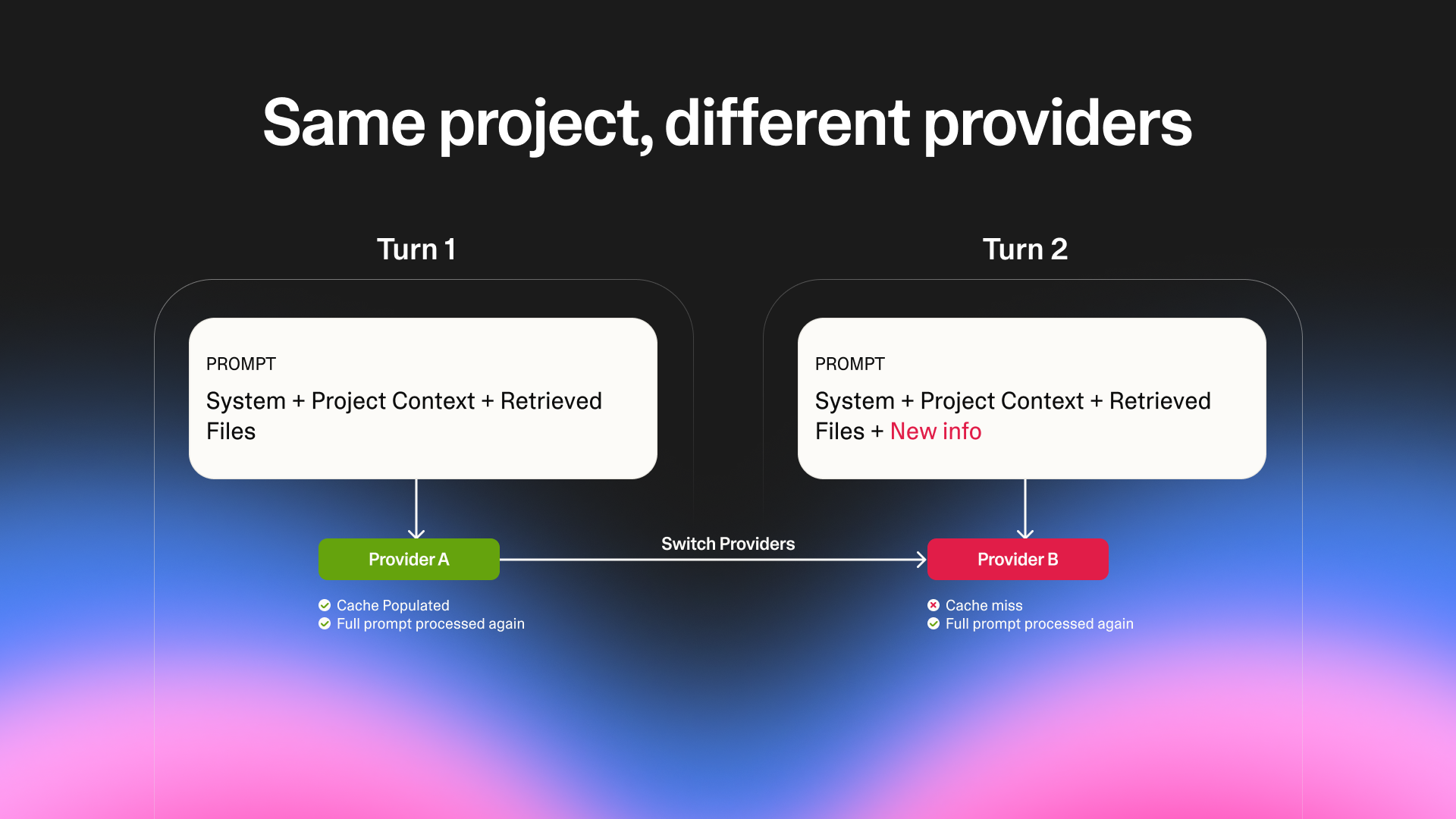
This is inefficient and expensive, but it gets worse. The rate limits that LLM providers impose on us are primarily defined in terms of the number of non-cached tokens that we send them, so if we do a poor job here, we could deplete all our capacity across all providers, meaning we'd have to rate-limit our users.
To prevent that from happening, simple fallback chains aren't enough. We need a form of load balancing that spreads traffic across providers so that each one stays within its capacity, while also keeping consecutive requests for the same project on the same provider as much as possible.
How it works: Multiple fallback chains and project-level affinity
To preserve prompt caching while still handling failures, we don't rely on a single global fallback chain. Instead, we generate multiple fallback chains with different providers as the first choice. Each project is assigned one of these chains and keeps it for a short window of time, so that consecutive requests for the project are routed consistently.
The fallback chains themselves are constructed probabilistically. Conceptually, the algorithm works like this:
- Start with a set of weights representing what fraction of the traffic each provider should receive.
- Sample the first provider in the chain, where the probability of picking each provider is proportional to its weight.
- Sample the second provider from the remaining providers, again proportional to their weights.
- Continue until all providers have been picked and we have a full permutation.
This gives us a space of possible fallback chains where providers with higher weights are more likely to appear earlier, but no provider appears more than once in a chain.
Choosing provider weights
When we first implemented load balancing, we set provider weights manually based on our understanding of capacity and our provider preferences. In practice, this turned out to be painful to maintain.
Different providers measure tokens differently. Some include cached tokens in their rate limits, and others don't, which makes it hard to compare stated limits directly. On top of that, provider capacity isn't static. Incidents happen, rate limits change, and effective throughput varies with traffic patterns.
When a provider started returning errors, we would have to manually reduce its weight to send less traffic its way. When conditions improved, we'd have to adjust it again. This required constant attention and made it hard to reason about whether we were actually using available capacity efficiently.
So instead of managing weights by hand, we moved to adjusting them automatically based on observed behavior. In practice, this has two steps:
- Continuously calculating availability for each provider using a PID controller. This lets us predict how much of our traffic a provider can handle at any given time.
- Using that availability to calculate the weights. In this step, we incorporate our preferred order of providers into the calculation.
Calculating provider availability
To continually assess provider capacity, we assign each provider an availability that is initially set to 1, representing that the provider is healthy. Every 30 seconds, we compute a score for each provider based on recent traffic:
score = (number of successful responses) - 200 × (number of errors) + 1
We then use a PID controller to adjust the provider's availability, trying to keep this score close to zero.
- If the score is negative (in other words, if the error rate rises above 0.5%), we reduce the availability so that the provider receives less traffic.
- If the score is positive, we increase the availability so that the provider receives more traffic.
- If we didn't use the provider at all, then the bias (the + 1) causes us to increase the availability slightly to prevent us from giving up on the provider forever, even if it failed previously.
- We cap availabilities to the range [0, 1].
Calculating provider weights
At any given time, the sum of all provider availabilities will often exceed 1. This simply means that, in aggregate, providers can handle more traffic than we currently have. That gives us flexibility: Since we only need the weights to sum to 1, we can choose which capacity to maximize and which to underutilize.
We work off of our preferred order of providers (the order in which we would ideally send traffic to providers, due to observed speed, model behavior, or operational requirements), and calculate weights as follows:
- For the first provider in the preferred order, the weight is its current availability.
- For the second provider, the weight is the minimum of its current availability and 1 - (weight of the first provider).
- For the third provider, the weight is the minimum of its current availability and 1 - (sum of weights of the previous providers).
- And so on.
This way, preferred providers are favored, with less preferred providers only receiving traffic when others are at capacity.
We sample a fallback permutation using these weights and cache that permutation for the project. For the next few minutes, that project will keep using the same fallback chain, which preserves prompt caching across turns.
Handling streaming failures
Not all failures happen before a response starts. In some cases, a request begins streaming a response and then fails partway through. By that point, the user may already have seen part of the output, and simply retrying the request from scratch on another provider would produce duplicated or inconsistent text.
To handle this, we take advantage of the fact that Claude models support prefilled responses. When a stream fails, we take the original request, append the partial response that was already emitted, and send that combined prompt to a Claude model. This allows the model to continue generating from where the previous response stopped.
Not all models support this mechanism, and even when they do, the continuation may differ slightly in style or wording. In practice, however, this produces much better results than aborting the response or restarting generation entirely. Importantly, this logic fits naturally into the same fallback-chain mechanism used for request-level failures.
Wrapping up
The system described here grew out of fairly specific constraints: we needed to spread traffic across multiple LLM providers while taking into account both our preference between different providers and the providers' fluctuating capacities, all without constantly switching providers for the same project.
Using multiple fallback chains with project-level affinity gives us a way to preserve the benefits of prompt caching. By automatically re-weighting providers based on live traffic, the system can maximize capacity at preferred providers and back off smoothly when errors appear. In practice, this means that Lovable rarely experiences outages due to LLM provider issues.
To make the load balancer behavior easier to explore, we've built a small Lovable app that simulates the load balancer. It allows you to experiment with provider capacity and failure scenarios and see how fallback chains, weights, and stickiness interact over time.
And if you're interested in working on problems like these, take a look at our open roles.